

As someone who has spent more than a decade working across brand, digital and growth, I felt the itch to look at this topic more closely. Whenever I state facts, they come from verifiable and reputable sources. Whenever something is interpretation, it is labelled as such.
The real trigger for this article happened during a workshop at Startup Nights.
An SEO specialist from the classic world of “keywords, keywords, keywords” said something I did not expect:
“Keywords are losing relevance. Brand and PR are becoming crucial for visibility.”
When performance marketers start talking like brand strategists, you know something fundamental is shifting.
So let’s unpack this. Calmly, logically, fact-based where possible and opinionated where useful.
1. What the numbers actually say about AI Search and classic search
Let’s begin with the part where the hype is usually loudest.
Google still completely dominates global search volume
Across reputable sources (Statista, SEO.ai, SQMagazine and Alphabet earnings reports), the picture is consistent:
Google handles around 8.3–8.5 billion searches per day
Google holds more than 80% of the global search market and over 90% on mobile
Google has historically stated that around 15% of searches each day are entirely new queries
(Based on Google’s own public disclosures, most notably from 2017–2018. Recent updates have not been officially published.)
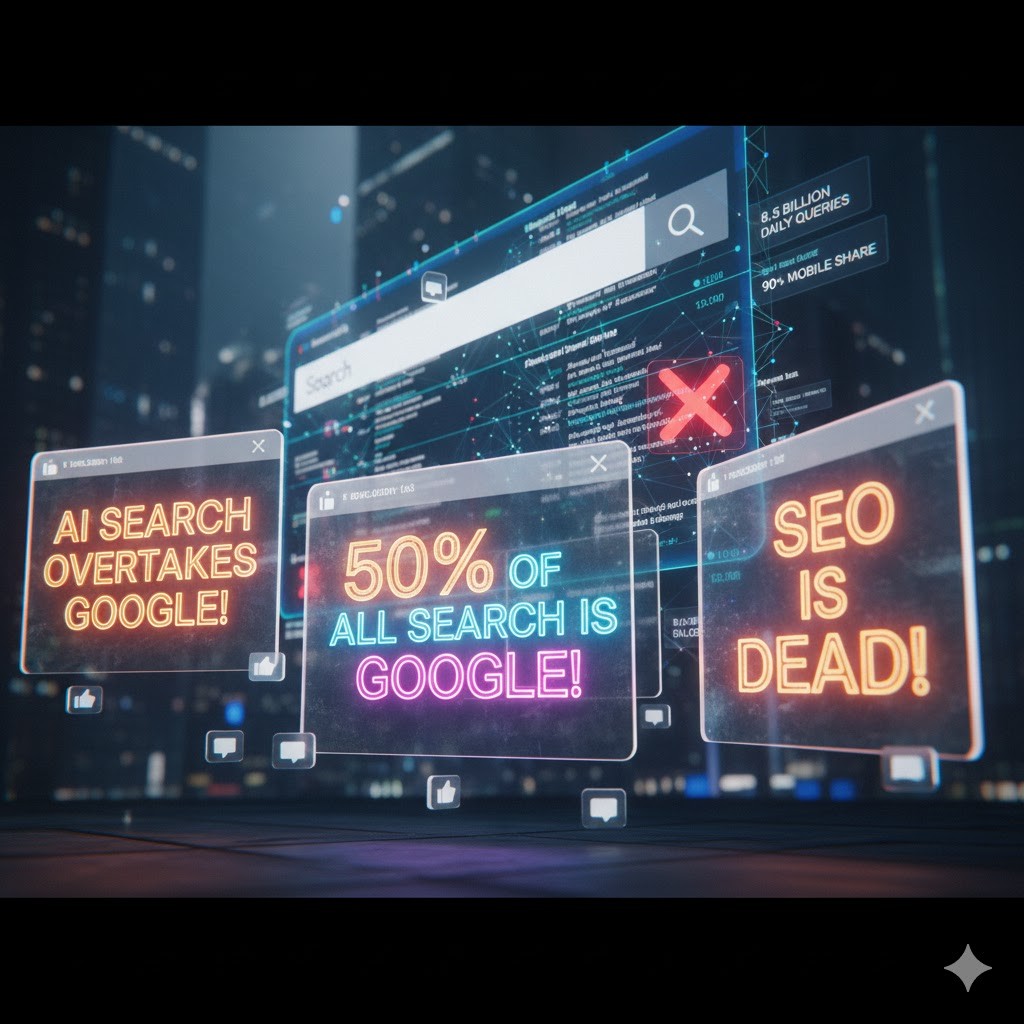
So the idea that AI has “overtaken search” or “replaced Google” is simply not supported by the numbers.
AI Overviews (AIOs) are growing, but far from dominant
Across studies by BrightEdge, Search Engine Journal, SEO Clarity, STAT and iPullRank:
Only 8.5–18% of tracked keywords trigger an AI Overview
In some categories (health, education), penetration is notably higher
Independent tracking tools show a dramatic increase in AIO-triggering keywords over the past year, though specific counts vary by tool
When an AI Overview appears, the #1 organic result may lose 15–34% of CTR depending on the study
(Ranges reported by Similarweb, iPullRank and other SERP behaviour analysts)
AI is shaping search behaviour — but it is not replacing classic search today.
And Google has no incentive to cannibalise its primary revenue engine overnight.
LLM query volume is meaningful, but not comparable to Google
Based on reporting by TechRadar, OpenAI usage disclosures, Anthropic commentary, Google’s Gemini updates and third-party modelling:
ChatGPT processes roughly 2.5 billion prompts per day
Only a portion of these are “search-like”; modelling estimates around 30%, equalling roughly 750 million search-like prompts
Other LLMs (Gemini, Claude, Perplexity) add around 450 million search-like prompts
In total: ~1.2 billion search-like interactions across major LLMs
For comparison:
Google classic search queries remain in the several billions per day
Similarweb’s SERP behaviour analyses confirm that a large share of searches end in zero clicks, though exact volumes differ across reports
(Similarweb publishes ongoing zero-click trend reports; 2023–2024 analyses show persistent high zero-click levels)
Conclusion:
AI search is not dominant in volume, but it is transforming the model and logic of visibility.
2. How LLMs search and why this is the real paradigm shift
One of the biggest misconceptions is that LLM search is simply “Google 2.0”.
It isn’t.
Historically (GPT-3 and early GPT-4)
LLMs answered based on:
training data
pattern recognition
probabilistic inference
no real-time web access
Today (GPT-5, Gemini 2, Claude 3.5 and similar models)
Depending on the query, LLMs now:
fetch information from the web in real time
consult multiple sources
evaluate trust, authority, relevance and recency
synthesise coherent answers
present results directly in the chat interface
This is fundamentally different from classic search.
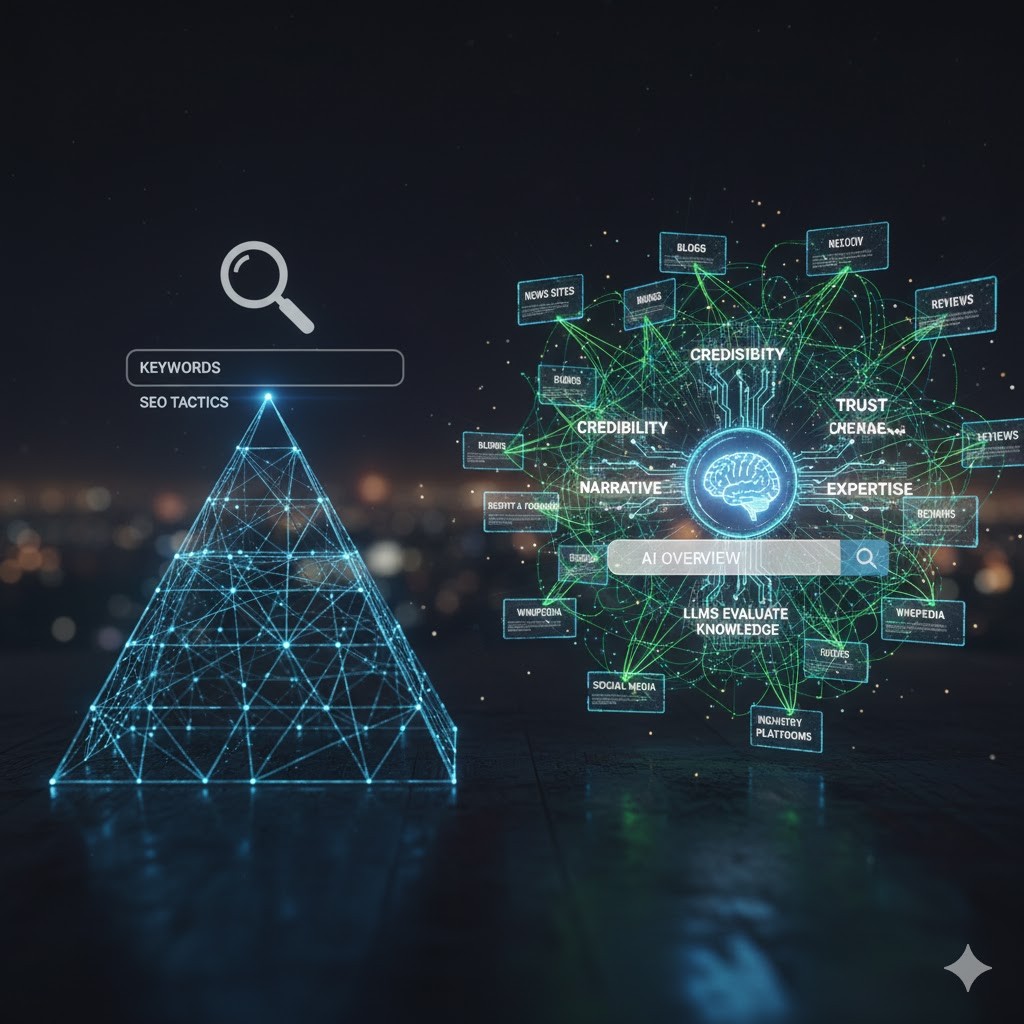
Google ranks pages.
LLMs evaluate knowledge.
Classic search rewards keyword optimisation.
LLM search rewards credibility, consistency and distributed trust signals.
This shift alone has enormous implications for marketing.
3. What this means for marketing and why we need nuance
The rise of AI Overviews and AI powered search does not simply add another layer to the existing digital ecosystem. It changes some of its foundations. But despite the loud claims on social media, we are not entering a world where everything flips overnight. The shift is real and significant, but it is also gradual and uneven.
To understand the implications, it helps to separate what we already know from what is developing and from what is still entirely unclear.
What is already clear and observable
The role of the website is changing.
This does not mean websites will disappear, but their function is beginning to evolve. Traditionally the website has been the single central source of truth for a brand. In an AI driven environment this centrality weakens, because LLMs do not rely on one authoritative destination. They collect information from many places and blend it into an answer. As a result, a website becomes one source among many, not the place where every important story must be told.
Search intent is also splitting into two paths.
People still use Google for many queries, especially transactional ones, but they increasingly use AI tools to understand a topic, compare options or explore possibilities. This means that a brand must be visible and coherent across both environments and cannot rely on a single search ecosystem anymore.
Brand signals are becoming more important.
LLMs reward credibility, expertise and consistency across multiple sources. That makes brand strength and brand clarity essential visibility drivers. A strong brand presence does not just influence humans, but also the way AI systems interpret authority and trustworthiness.
Content must be readable by both humans and machines.
LLMs can interpret complex writing, but they work best when content is structured, clear and information rich. This requires a more disciplined approach to how brands write, organise and maintain their digital footprint.
Finally, keywords are already losing relevance as visibility indicators.
In an LLM environment, words matter less than meaning, clarity, trust signals and the overall coherence of information across channels.
What is likely but not guaranteed
Websites will probably become more machine readable.
Instead of visually heavy designs with complex navigation structures, we may see a gradual shift toward simpler and more structured formats that are easier for AI tools to interpret. It is possible that brands will introduce dedicated FAQ layers or knowledge sections that serve both humans and LLMs.
Some companies might even move toward data first web structures.
These are formats that behave more like structured databases than traditional websites. They resemble what applicant tracking systems do in recruiting. It is speculative, but it is a reasonable direction if machines become the primary consumers of content.
Another likely development is that more transactions will happen inside conversational AI interfaces.
If a tool can recommend, compare and purchase in one integrated flow, it reduces the need to visit a website at all. This feels plausible, but we are still early.
What is not yet clear
There are also major questions that no one can answer yet.
We do not know whether websites will lose their anchor role entirely. We do not know which structured data standards will become dominant. And we do not know how quickly consumers will move from a Google first habit to an AI first habit. Human behaviour changes slowly, even when technology advances quickly.
The only honest conclusion is this:
We know enough to say the shift will be significant, but we do not know enough to claim that any single future model is guaranteed. The transformation is real, but it is not binary. And that makes it one of the most fascinating changes in marketing in years.
4. What brands should do now
This is where brand building and behavioural science from researchers like Les Binet, Daniel Kahneman and Byron Sharp become directly relevant to search.
LLMs behave in surprisingly human ways.
LLMs trust what is consistent and credible
When LLMs gather information, they behave surprisingly similarly to how humans build trust. They do not simply match keywords. They look for patterns, repetition, coherence and authority. That is why the following signals matter so much:
• sources that appear frequently
Frequent exposure has always been a strong psychological cue for trust. Humans rely on it and so do machines. When a brand is mentioned often across the web, it becomes more likely to be surfaced as relevant or authoritative.
• sources that appear across many reputable platforms
If a brand shows up consistently in credible environments such as respected publications, established industry sites or reliable user communities, LLMs treat that as a sign of legitimacy. One isolated page rarely moves the needle.
• sources that show depth, clarity and expertise
AI tools prioritise information that is detailed, well explained and aligned across multiple references. Depth signals competence and reduces uncertainty, both for humans and for machine models.
• narratives that are consistent across channels
LLMs reward coherence. When a brand tells the same story across websites, articles, interviews, social platforms and reviews, the model can more easily understand what the brand stands for. This mirrors how humans form stable mental representations of brands.
In simple terms, this is mental availability applied to machines.
The more often a brand shows up in credible, consistent ways, the more likely it is that an LLM will surface it.
Distributed presence is more powerful than perfect SEO
LLMs do not rely on one source. They scan a wide landscape and merge signals into a complete picture. This means visibility becomes a network effect rather than a single channel game.
They pull from places such as:
• news sites
• blogs
• reviews
• Reddit and other forums
• Wikipedia
• industry platforms
• social media
• your own website
A single optimised page cannot dominate this environment.
Visibility comes from a distributed presence across many trustworthy sources.
This is a major shift.
The strongest brands will be the ones that show up often, in many places and with consistent meaning. SEO as a narrow technical discipline becomes less predictive, while brand building and content distribution become more strategic than ever.
Content must shift toward depth and expertise
Simple factual content is increasingly answered directly by AI tools.
This means brands have a choice. They can continue producing content that machines will summarise in one sentence, or they can focus on the kind of value that AI cannot easily recreate.
The most future proof content includes:
• analysis
• perspective
• opinion
• narrative
• deep expertise
• real experience
This is content that shows understanding, judgment and creativity.
It helps machines understand what the brand stands for, and it helps humans feel why it matters.
In other words, content must move beyond information and toward meaning.
5. Who wins in AI search and why it is not only large brands
There is a common belief that AI driven search will benefit big brands and make it nearly impossible for smaller players to compete. The reality is more nuanced. Some advantages shift toward large brands, but others open up new opportunities for challengers. The playing field changes, but it does not disappear.
The advantages of large brands
• more historical mentions
Large brands simply appear more often across digital touchpoints. Over time this creates a broad information footprint that LLMs can reference. This accumulated presence makes it easier for AI systems to treat them as established and reliable.
• larger PR and communication structures
A well funded organisation can put out more stories, more interviews and more coverage across a wide variety of platforms. This leads to a stronger network of references that benefit AI visibility.
• more structured information in more places
Bigger companies tend to invest in consistency, knowledge bases, documentation and well managed websites. These structured signals help machines understand the brand clearly.
• broader reach across high credibility environments
Larger brands appear more frequently in respected publications, trusted partner platforms and widely recognised media. These placements are highly valuable for LLM interpretation.
The advantages of challenger brands
However, challengers have their own strengths, and some of them matter even more in an LLM driven environment.
• credibility in user led spaces such as Reddit, comparison platforms and review sites
Consumers often trust peer generated spaces more than official brand channels. LLMs pick up on this dynamic. A small brand with strong community driven credibility can outperform a giant that lacks authenticity.
• faster positioning
Smaller brands can adjust their messaging quickly, refine their category narrative and respond to cultural signals in real time. This agility helps them create consistent stories that machines can understand.
• strong expert presence in niche categories
LLMs reward depth and clarity. A specialist brand that focuses on a specific niche can become the most referenced voice within that space, even if its total scale is small.
• faster adaptation of distribution strategies
Challenger brands often experiment earlier with new channels, formats and communities. They spread their presence across many smaller but credible touchpoints, which strengthens the distributed network effect that LLMs depend on.
The overall pattern
AI search rewards breadth, depth, credibility and consistency.
Not only size.
Money still buys reach in high trust environments, and established players often start with advantages because their footprint is already large. Smaller brands still face an uphill climb, but that is already the nature of competitive markets. What changes is the shape of the hill.
In many ways, AI search gives challenger brands a better chance to become relevant, because one massive website with millions of visitors matters less than a broad set of high quality references across many sources.
In simple terms:
• large brands win through scale
• new brands win through speed and trust
Both can succeed if they invest in distributed visibility and long term brand building.
6. The bigger picture and the merging of brand marketing with search
This is where everything comes together.
Search is no longer a narrow technical discipline. It is no longer just a keyword checklist or a landing page optimisation exercise. The rise of AI Overviews and LLM driven answers turns search into something much deeper and much closer to the core of brand strategy.
Search increasingly becomes a reflection of brand strength.
• brand perception
How people talk about the brand and how they feel about it influences how machines interpret its relevance.
• brand credibility
Consistent signals from trustworthy environments make AI systems more confident when referencing a brand.
• brand salience
Brands that remain mentally available to humans also tend to appear more often in AI accessible content. This matters for visibility.
• brand distribution
The wider the spread across articles, communities, reviews and platforms, the stronger the overall signal for an LLM.
• brand storytelling
Clear, coherent narratives help machines understand what a brand stands for and when it is relevant.
• brand consistency
Mixed or conflicting messages confuse humans and machines alike. Consistency becomes a strategic advantage.
Or, as I like to say:
A brand is the sum of every touchpoint people have with it.
Now it is also the sum of every touchpoint machines have with it.
Brand marketing no longer only shapes preference.
It now directly shapes how AI systems understand your meaning, authority and relevance within a category.
Brand builds demand.
Brand signals trust.
Brand shapes human memory.
Brand shapes AI memory.
Because of this, brand marketing is more commercially relevant today than at any other time in the digital era.
Long live brand marketing.
Source List
Search volume, market share, AI Overviews
Exploding Topics: https://explodingtopics.com/blog/google-searches-per-day
SQMagazine: https://sqmagazine.co.uk/google-search-statistics/
BrightEdge AIO Analysis:
https://www.brightedge.com/news/press-releases/one-year-google-ai-overviews-brightedge-data-reveals-google-search-usageSearch Engine Journal AIO Tracking:
https://www.searchenginejournal.com/google-ai-overviews-overlaps-organic-search-by-54/557317/iPullRank AIO Study:
https://ipullrank.com/everything-we-know-about-ai-overviewsSimilarweb SERP & Zero-Click Trend Analyses:
https://www.similarweb.com
LLM usage & prompt volume
OpenAI: https://openai.com
Anthropic: https://www.anthropic.com
Google Gemini: https://ai.google.dev/gemini
Conceptual & behavioural science
Binet & Field – “The Long and the Short of It”
Kahneman – “Thinking, Fast and Slow”
Sharp – “How Brands Grow”